

XO INVESTMENTS’ services for private clients range from wealth management to pension advice.
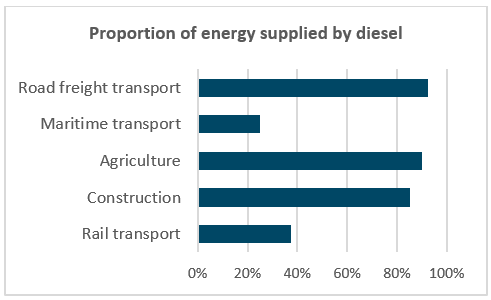
Although it receives less media attention than Brent or WTI, diesel is the true backbone of the global economy. It powers the trucks that transport goods, the ships that facilitate international trade, the farm machinery that produces our food, and a large portion of industrial equipment. When diesel becomes scarce or its price skyrockets, the entire global supply chain comes under pressure.
For several months now, a number of factors have been contributing to tightness in the diesel market.
On the one hand, Russia—long one of the world’s leading diesel exporters—has restricted its exports to secure its domestic supply. These measures come amid repeated attacks on certain Russian energy and logistics infrastructure. The reduction in Russian exports is thus removing several hundred thousand barrels per day from the international market.
On the other hand, geopolitical tensions in the Middle East continue to pose a risk to the main routes of global energy trade. The Strait of Hormuz remains a strategic chokepoint for a significant portion of global exports of crude oil and refined products. Any sustained disruption in this area would immediately result in higher costs for maritime transport and energy supplies.

This situation comes at a time when several regions of the world are already experiencing relatively low inventory levels. The market therefore finds itself in a situation where even the slightest additional incident could trigger another price spike.
The problem is not limited to available volumes. Global supply chains are also facing increasing constraints. According to a recent analysis by Apollo Global Management, disruptions on certain strategic shipping routes are forcing carriers to extend their voyages by an average of about nine days. These detours increase transportation costs, require more fuel, and cause delays in the delivery of goods. Apollo estimates that these additional logistics costs are helping to maintain inflationary pressure on the global economy and could limit central banks’ ability to ease monetary policy.
This observation highlights an often-overlooked reality: inflation is not solely a matter of money supply or consumption. It also depends on the efficiency of supply chains. When goods take longer to travel and transportation costs rise, these increases are ultimately passed on to consumers.

Diesel thus finds itself at the center of a vicious cycle. Logistical disruptions increase its consumption; this rise in demand drives up prices; and these higher prices, in turn, make the entire transportation system more expensive.
Unlike gasoline, which is primarily used for personal transportation, diesel is directly linked to economic activity. The road transport, construction, agriculture, logistics, and industrial sectors rely heavily on this fuel. A sustained rise in its price therefore acts as an invisible tax on the entire economy.
Transportation companies are seeing their costs rise. Farmers are paying more to operate their equipment. Distributors are facing higher logistics costs. These costs are then gradually passed on to the final price of goods and services.

The price of diesel illustrates its strategic role: it reacts strongly to geopolitical tensions, but is also linked to inflationary pressures, as shown in the chart above. Following the period of disinflation observed between 2022 and the first quarter of 2026, its recent rise could become one of the factors likely to jeopardise the return to price stability anticipated by central banks.
For Switzerland, this issue also warrants special attention. Our country has virtually no domestic fossil fuel resources and relies heavily on imports to meet its fuel requirements. Refining capacity in Switzerland has also been significantly reduced over time. The Confederation, moreover, considers that.

The report by the Federal Office for Civil Protection emphasizes that a shortage could result from several simultaneous factors: reduced supply from producing countries, refining problems, disruptions to European rail traffic, supply difficulties via the Rhine, or breakdowns in logistics infrastructure. The more these events occur simultaneously, the greater the risk.
The Swiss authorities do, however, have a particularly valuable tool at their disposal: mandatory reserves. These reserves – which apply not only to the energy sector but also to food, medicinal products and industry – are subject to quantitative requirements with a view to ensuring Switzerland’s security of supply. For energy products, the quantities to be stockpiled must cover 4.5 months’ consumption, calculated on the basis of the previous three years.
These reserves were already tapped during the droughts that significantly reduced traffic on the Rhine in 2018 and 2022. The current drought, coupled with the Russian decision and the Strait of Hormuz, represents a combination of factors that is putting strategic reserves to the test. They are not a miracle solution. They protect against a temporary shortage but cannot offset the economic effects of a sustained rise in global prices.
In the face of tensions surrounding fossil diesel, an alternative solution is attracting increasing attention: HVO100 (Hydrotreated Vegetable Oil) renewable diesel. Unlike traditional biodiesel, HVO100 is produced by hydrogenating used vegetable oils, residual fats, or waste from the food industry. Its main advantage lies in its near-total compatibility with existing diesel engines and current distribution infrastructure.
The process is relatively simple: cooking oils collected from restaurants, the food processing industry, or households are processed in specialized refineries to produce a fuel whose characteristics closely resemble those of conventional diesel.
The environmental benefits are significant. According to producers, greenhouse gas emissions can be reduced by as much as 80 to 90 percent over the entire life cycle compared to fossil diesel. The fuel also emits fewer fine particles and requires little or no vehicle modifications.
However, this solution faces a fundamental constraint: the availability of raw materials. The European Union produced approximately 3.9 million metric tons of HVO in 2025, compared to a total of 14.7 million metric tons of biofuels. The majority of raw materials now come from waste and residues, which account for about 55% of the production mix.
By comparison, global diesel fuel consumption runs into tens of millions of barrels per day.
Even though production capacity is growing rapidly, the International Energy Agency estimates that the combined global capacity for renewable diesel and sustainable fuels is expected to reach approximately 800,000 barrels per day
In other words, french fries won’t replace oil.
However, they can help gradually reduce dependence on fossil diesel in certain sectors that are difficult to electrify, including heavy-duty trucks, agricultural machinery, construction equipment, and certain industrial applications.
This limitation is significant because it illustrates the current energy challenge: even when technologies exist, their large-scale deployment requires time, investment, and sufficient resources.
Economic history shows that periods of inflation often originate in the energy and commodities sectors. Today, the diesel market exhibits several characteristics that warrant investors’ attention: tight inventories, persistent geopolitical tensions, fragile supply chains, and the global economy’s continued heavy reliance on fossil fuels.
For investors, several developments warrant close monitoring:
Having dominated the debate in 2022 and 2023, inflation appeared to be gradually coming under control for several quarters. Following the crisis in the Middle East, inflationary pressures have returned to the forefront. Diesel, that unassuming yet essential commodity, could thus once again become a particularly relevant leading indicator for anticipating future price pressures and, consequently, the decisions of central banks.minating the debate in 2022 and 2023, inflation seemed to be gradually coming under control. However, one of the main risks in the coming quarters could well come from a discreet but essential player: the fuel that powers the global economy. Diesel could thus once again become a particularly relevant leading indicator for anticipating upcoming price pressures and, consequently, the decision of centra banks.