

XO INVESTMENTS’ services for private clients range from wealth management to pension advice.
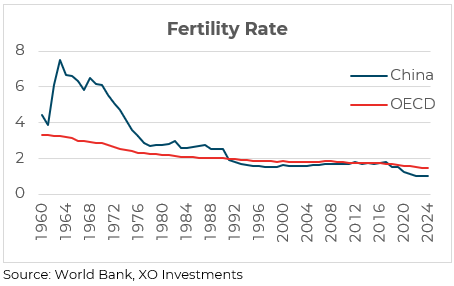
Since the first half of the last century, Chinese authorities have considered population growth to be too rapid. This observation echoes—albeit in a very different context—recent political developments in Switzerland! Since the problem stems from internal population dynamics rather than a positive net migration, Chinese authorities have implemented several population control measures . Initially, these measures were voluntary and applied inconsistently across the country. Around 1980, the central government imposed the one-child policy. It combined financial incentives, access to contraception, administrative sanctions, and, in some cases, coercive measures. In the period following the introduction of these measures, the fertility rate (measured as the average number of births per woman) fell sharply in China, although it is impossible to attribute this result with certainty to any specific measure. Since 1990, China’s fertility rate has even been lower than that of OECD countries.
As is often the case, the reality is more complex: what may appear to be a statistical success masks side effects that are far from trivial. The one-child policy has, in fact, contributed to exacerbating several anomalies: a gender imbalance, accelerated population aging, a gradual contraction of the labor force, and the emergence of generations of only children who bear an increased family burden. Its formal abandonment in 2016, followed by the shift to a two-child and then a three-child policy, illustrates a complete shift in the authorities’ priorities: after seeking to limit births, China is now attempting to encourage them, though it has not yet managed to sustainably reverse the family preferences and economic constraints weighing on young households.

Faced with these imbalances, the authorities have gradually abandoned the strict logic of birth control. Starting in 2011, couples were allowed to have a second child if both parents were themselves only children (“double-only”). In 2014, this option was extended to couples in which only one parent is an only child (“single-only”). These reforms paved the way for the widespread end of the one-child policy in 2016. In 2021, Beijing raised the limit to three children per couple. These changes are therefore not merely an administrative relaxation: they mark the transition from a birth control policy to an explicitly pro-natalist policy, justified by the desire to slow population aging, support the future workforce, and reduce the economic pressures associated with the growing dependency of the elderly.
This shift in policy has also resulted in a series of pro-natalist measures designed to reduce the economic and social costs of raising children. Beijing has encouraged the development of daycare centers and childcare services, the extension of parental leave, and adjustments to work schedules. The authorities have also provided tax breaks, housing assistance for families, and improved reimbursement for medical services related to maternity and fertility. Since 2024, the approach has broadened further with the goal of creating a society that is more “birth-friendly”: After long telling families that one child was more than enough, the government is now trying to make having a second or third child a little less of a deterrent.
The demographic arsenal deployed by the Chinese authorities is impressive in terms of the number, diversity, and scope of the measures employed. At first glance, everything seems in place to guarantee success. It’s as if demographics—and therefore women—were expected to obey the government’s will! In reality, these measures have had limited effects: the number of births in China has continued to decline and reached an all-time low in 2022.

An international comparison of birth rates highlights two key points: first, the motivations that led Chinese authorities to adopt pro-birth policies, and second, the extent of their failure.

Since the early 1990s, China’s fertility rate has been converging closely with that of many Western countries, and is even lower than that of the U.S. A persistently low fertility rate has significant repercussions on a country’s economy, as it gradually reduces the labor force, increases the relative share of retirees, and puts pressure on economic growth, public finances, and pension systems. This is likely one of the reasons that prompted Chinese authorities to relax population control measures. China’s fertility rate has continued to decline more rapidly than that of other global economies, as illustrated by the chart above. Since 2020, China’s fertility rate has even fallen below that of Japan, a country considered one of the most striking examples of demographic decline among developed nations. Japan is, in fact, a particularly interesting case study for China because, despite the absence of a birth-control policy, the country has long experienced a low birth rate and a pronounced aging population.
This failure has naturally drawn the attention of researchers, and their conclusions are consistent: birth rates depend on what women (or couples) actually want, not on what the government allows! The data show that the abandonment of the “ ” one-child policy increased births only among women who already wanted two or more children, without changing the behavior of those who wanted only one. This interpretation is consistent with the fact that the decline in Chinese fertility had already begun before the one-child policy, particularly as a result of campaigns in the 1970s encouraging later marriages, longer intervals between births, and smaller families.
The problem is therefore not regulatory in nature: it stems from family preferences themselves, shaped by economic factors (the cost of housing, education, and childcare) but certainly not by sociocultural factors such as the trade-off between motherhood, career, and personal autonomy. In other words, China is grappling less with a public policy issue than with a lasting shift in social behavior. For families, small household sizes have become the norm, and relaxing the rules is not enough to encourage a rebound in the birth rate. Despite this, Chinese authorities have decided to extend measures to an area that would have seemed unthinkable just a few years ago: contraception. Effective January 1, 2026, condoms and hormonal contraceptives will no longer be eligible for the tax exemption they have enjoyed since the early 1990s and will now be subject to a 13% VAT. This development illustrates just how far the authorities are willing to go to utilize every available tool.
The Chinese case highlights a more general challenge: public policies are largely ineffective when they seek to transform deeply ingrained preferences. Sociocultural norms are rooted in habits, expectations, and collective perceptions of what constitutes a “normal” life. This is why a law may permit a certain behavior and a financial incentive may make it less costly, yet neither is sufficient to change habits that have become socially entrenched.
There are numerous examples:
In all these cases, the government can change the rules of the game and increase incentives, but it cannot instantly transform the preferences, habits, and collective perceptions that guide behavior.