

XO INVESTMENTS’ services for private clients range from wealth management to pension advice.
Créée par Elon Musk en 2002, SpaceX a été fondée avec l’ambition de réduire le coût d’accès à l’espace et de développer des capacités permettant, à long terme, des missions habitées vers Mars. L’entreprise est surtout connue pour ses lanceurs réutilisables, désormais utilisés par la NASA pour ravitailler la Station spatiale internationale. Au cours du temps, SpaceX a toutefois élargi son champ d’activité autour de trois pôles distincts : l’espace, la connectivité et depuis très récemment l’intelligence artificielle. Le segment connectivité repose sur Starlink, qui fournit depuis 2019 un accès à Internet par satellite au moyen d’un réseau d’environ 10’000 satellites. La fusion avec xAI en février 2026 a ajouté une composante liée à l’intelligence artificielle (IA) au périmètre du groupe. Ces trois activités présentent aujourd’hui des profils et des dynamiques très différents.
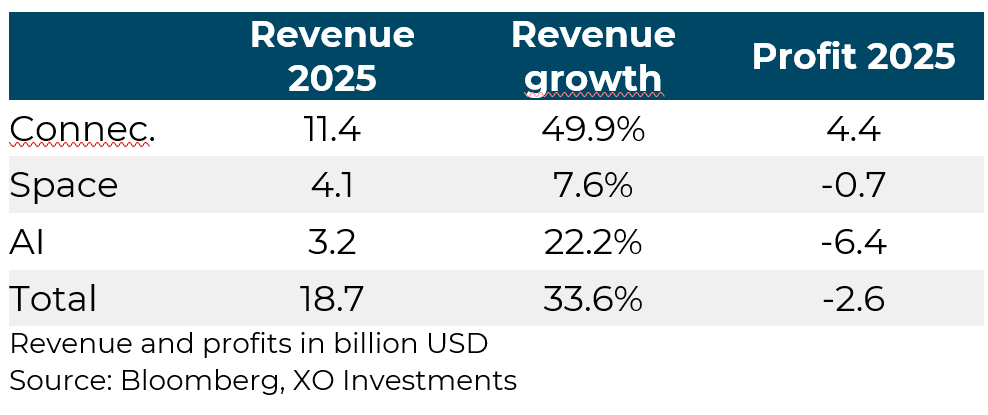
Connectivity, the only profitable segment, is growing strongly. The space segment requires investment, particularly in research and development, which weighs heavily on profits. The AI segment also ended 2025 at a loss due to the capital expenditure required to maintain the infrastructure. As such, SpaceX is a company that is not currently generating profits.
Until recently, SpaceX was a private company and was classified as a ‘unicorn’ – that is, a company valued at over $1 billion without being listed on a stock exchange or affiliated with a major group. On 12 June, its shares began trading on the Nasdaq, the US stock market primarily associated with technology and growth companies. At the time of its initial public offering (IPO), SpaceX was valued at approximately 1,750 billion USD.
The IPO comes after the bulk of the value creation has taken place in the private markets. As illustrated by the chart below, SpaceX’s valuation rose from $74 billion in early 2021 to $210 billion in mid-2024, and then to $350 billion during the takeover bid in December 2024. It then reached $800 billion a year later, before reaching an implied value of $1,000 billion at the time of the merger with xAI in February 2026. SpaceX’s implied valuation at the time of the IPO was $1,770 billion.

The IPO was very well received by investors. Listed at 135 USD, the share closed its first trading session at 160.95 USD, representing a rise of 19.2 per cent. The enthusiasm continued in the days that followed, with the share price rising above $225 (+66.7%), before falling back to around $153, which still represents an increase of around 13.5% compared with the IPO price. Over the same period, the Nasdaq technology index fell by 2%.

With the share price exceeding USD 225, SpaceX’s market capitalisation reached almost USD 3,000 billion and temporarily overtook Microsoft as the world’s fourth-largest company. At the current price, SpaceX ranks sixth in the global list of the largest companies. Two observations emerge from this ranking. Firstly, one has to go down to seventh place to find a non-US company, which reflects the heavy concentration of global equity markets around US firms. Secondly, the top eight companies all have activities related to artificial intelligence, whether as providers of solutions, infrastructure or key technologies.

Only 4 per cent of the company’s shares have been floated on the stock market, with the remainder remaining in private hands – for the time being, at least. Consequently, SpaceX currently accounts for a small weighting in stock market indices: approximately 0.5 per cent on the Nasdaq and 0.1 per cent on the Russell 3000. The providers of these indices have, however, put in place fast-track procedures to allow for the company’s quicker inclusion. S&P Dow Jones Indices, on the other hand, has not implemented a similar procedure. SpaceX has therefore not yet been included in the S&P 500, notably because it does not meet several criteria:
SpaceX’s weighting in the indices is nevertheless expected to increase gradually. As the lock-up periods for private investors expire, the free float is expected to widen, which would automatically lead to an increase in its weighting in the indices.
The market thus values SpaceX as one of the world’s largest companies despite its lack of profits. This valuation, however, is based on investors’ expectations, who believe that SpaceX will eventually be on a par with the world’s leading companies.

However, such a valuation implies extremely ambitious growth scenarios based, in particular, on the following assumptions:
The expectations factored into the share price are therefore high, and several risks remain: intensifying competition in satellite telecommunications; delays or technical difficulties with the Starship rocket; regulatory and geopolitical constraints; difficulty in monetising investments in AI; and continued high levels of capital expenditure.
SpaceX’s flotation marks a significant milestone in the history of the financial markets given its exceptional scale. It is, in fact, the largest IPO ever carried out: the sale of newly issued shares raised $85.7 billion, nearly three times the amount raised by Saudi Aramco in 2019, the previous record of $29.5 billion.
This IPO could pave the way for a wave of mega-IPOs. Unsurprisingly, these are technology-related companies, notably in artificial intelligence (OpenAI, Anthropic), fintech (Revolut, Stripe) and digital infrastructure (Databricks). What they have in common is that they have achieved very high valuations in the private markets, whilst requiring significant capital to fund their growth, particularly in data centres, computing, payments and financial services.

This wave of initial public offerings could reverse a trend observed in the US market since the early 2000s. For two decades, companies have bought back more shares than the market has created through IPOs and new share issues. This contraction in supply, combined with persistent demand for US shares, has supported prices and contributed to one of the longest bull markets in history. With the expected mega-IPOs, 2026 could thus mark a turning point by once again becoming a year of positive net supply for US shares.

For investors, this wave could broaden access to companies previously reserved for private capital, but it also raises a key question: will the public markets have the capacity to absorb this capital and, consequently, will they be prepared to value these companies at the same level as private investors?